Current Research Projects
Here you can read about the current research projects and the students behind them!
Habitat Selection and Genetics of Yellow Mud Turtles in Nebraska
By. Megan Soldatke
The Yellow Mud turtle (Kinosternon flavescens) is a small semi-aquatic turtle found in the Sandhills region and Southern Nebraska. It's thought that agricultural fields and the Platte River divide the two populations. My study uses telemetry to determine how the turtles use their surrounding habitat and movement capabilities. If these two populations are disconnected, then it would also reflect through genetic variation. Which is why genetic samples are taken from select populations and analyzed. This study will inform the connectivity and genetic health of these turtles in Nebraska.
Substrate and Moisture Range Parameters for Prairie Ringneck Snakes (Diadophis punctata). (Aug 2025)
By Emily Deming
Bullsnake Behavioral Response to Prey and Predator Olfactory Cues. (Aug. 2025)
By Sarah Springer
Bullsnake [Pituophis catenifer], is a colubrid subspecies of gopher snake native to the sandhills of Nebraska. This study aims to examine the chemosensory cues used by bullsnakes while searching for prey and the effects of predator scents during the search. The mesopredator black-footed ferret, Mustela nigripes, is found in black-tailed prairie dog towns alongside bullsnakes in pursuit of prey. Black-footed ferrets are obligate carnivores, preying only on black-tailed prairie dogs [Cynomys ludovicianus] in addition to living in their abandoned burrows. This project will help illuminate the interactions between bullsnakes and black-footed ferrets, such as whether they compete for prey resources, if one species is dominant over the other, and if the bullsnake is aggressive toward black-footed ferrets.
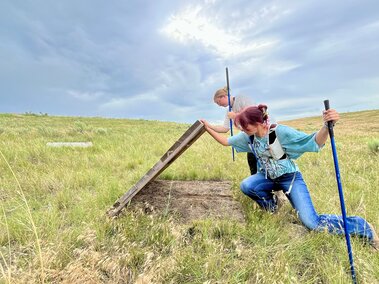
Lifted cover board Arrays analysis in different habitats in Keith Co. NE. (2025)
By Kendall Stemper & Jonnie Mahrt
Our research evolved from a class project in field herpetology to a study aimed at filling a gap in herpetological research. Our project explores how different coverboard structures—lifted versus flat—and their placement on varied substrates (wooded, rocky, prairie) influence snake activity. We installed 18 raised and 20 flat coverboards, with more to come, across the Cedar Point Biological Station. The raised boards were constructed with 1-inch planks, elevating them slightly above ground, creating microhabitats while maintaining environmental integrity. Every other board was given a Kestrel data logger to track temperature and humidity. So far, along with the capture of 10 snakes, we have been seeing an early correlation that our prairie snake species prefer the lifted boards.
Past Student Projects
Here you can read about previous research projects and the students behind them!
Ecological Insights into Translocated and Native Bullsnakes (Pituophis catenifer) (2024)
By Nia Meyer
Habitat loss and fragmentation in the Midwest have reduced bullsnake (Pituophis catenifer) populations and increased negative human–snake interactions. This project uses radio telemetry to study the movement and habitat use of native and augmented bullsnakes at Cedar Point Biological Station. By tracking snakes in a working agricultural landscape, the study helps fill gaps in knowledge about bullsnake spatial ecology and supports more effective, humane conservation strategies.
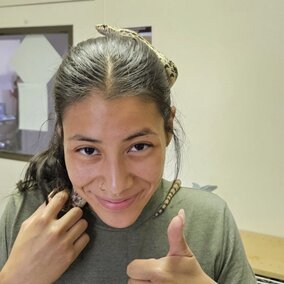
How Climate Change is Affecting the Western Tiger Salamander
By Hendy Ginting
A changing climate has lead to changes in the lengths of certain seasons. With that, many seasonal behaviours of various species will be affected by this. The Western Tiger Salamander (Ambystoma Mavortium) has the ability to leave ponds they inhabit as larvae by metamorphosis. In addition, during cold wintering seasons they will hibernate in the larval stage, under the ice and not metamorphosis. If the wintering season were to decrease, they A. mavortium larvae choose to metamorphosis? A trial is conducted involving 20 A. mavortium. The control group (10 individuals) will experience expected cold temperatures for the expected time period. The experimental group(10 individuals) will experience expected cold temperatures for only 2 weeks before temperatures in their tanks rise to simulate early end to the winter season. Number of metamorphosis events, duration until metamorphosis events, and behaviour will be recorded as well as various environmental parameters. It is predicted that the individuals in the experimental group will have more metamorphosis events, shorter duration until these events, and will be more active.
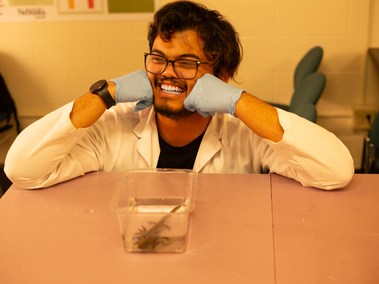
Effects of Dietary Patterns on Growth and Development of American Alligators & American Alligator Operant Conditioning Study
By Jordan Wattles
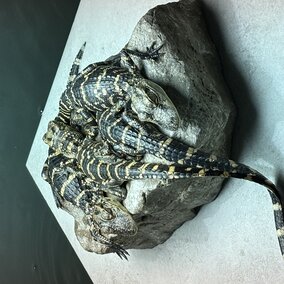
The experiment involves monitoring the growth and feeding behaviors of eight alligator hatchlings under controlled laboratory conditions. Four hatchlings are being fed chicken using tongs, while the remaining four are offered fish and other whole prey items to simulate natural free-will hunting scenarios. Weekly data collection includes weighing and measuring each hatchling, as well as recording the weight of the food provided prior to feeding. This study aims to evaluate the effects of feeding methods and diet types on alligator growth and development.
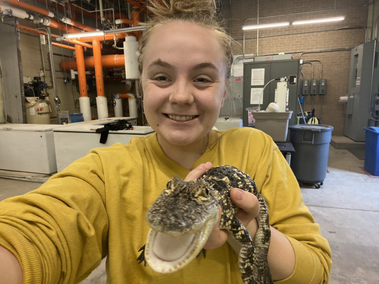
By Jordan Wattles
In my project I looked at 3 American alligators, a single 1-year-old, in which I conducted a growth study, and two 3-year-olds, in which I began the process of operant condition in order to support voluntary training procedures. During the operant conditioning process I had to change my approach. I originally began looking at the length of time it took for the individuals to respond to the auditory stimulus and I planned to look at how that response time changed over the project. Per Dennis’ request, I changed the project to support a quicker learning process as the individuals were associating any person interacting with them as a feeding time. I began using the auditory stimulus before feeding each individual to associate the food with noise. From there on the individuals no longer bothered others interacting with them.
The Effects of Diluted Fungicideon WesternTiger salamander Health (2023 -2024)
By Sage Veomett
Blanding’s Turtle Competition Study (2023-2025)
By Caitlyn Copenhaver
I studied and compared the amount of food eaten (as a portion of total body weight) and the amount of competition between 2 juvenile and 2 adult Blanding’s turtles, as well on taking measurements on weight and plastron/carapace length and width.
Where are they now?
Copenhaver graduated with a Bachelor of Science in Fisheries and Wildlife from the University of Nebraska-Lincoln (UNL) in the spring of 2024. Since that time, she has immersed herself in the field by serving as a Park Worker for the Nebraska Games and Parks Commission, where she has played a vital role in the stewardship of the state’s natural resources and the enhancement of public recreational spaces. In addition, Copenhaver has taken on the responsibilities of Assistant Herbarium Curator at UNL, where she contributes to the curation and management of vital botanical specimens, further enriching her expertise in conservation and biodiversity. Her combined experiences reflect a strong commitment to environmental science and community engagement, positioning her as a dedicated professional in the field.
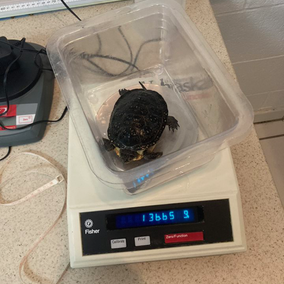
Evaluating American bullfrog (Lithobates catesbeianus) tadpole exposure to neonicotinoid and fungicide agrochemicals (2020-2023)
By Abi Schoup
Presence/Sbsence Surveys of Herpetofauna Species at Niobrara Valley Preserve (2020-2023)
By Matthew Klein
After graduating from UNL, Matthew began a master's degree at West Virginia University working with Dr. Eric Hileman. Matthew's current research is focused on applying quantitative approaches and models to understand the population ecology of threatened eastern massasauga rattlesnakes in Michigan. His work will answer questions related to how variation in survival and recruitment influence population growth and how inbreeding is impacting population extinction risk. This research is directly supporting conservation decision making amongst diverse collaborators and partners committed to eastern massasauga conservation.
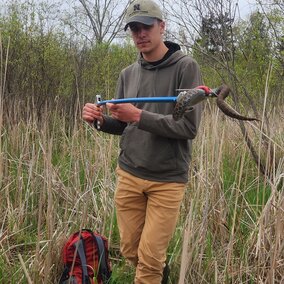
Nebraska’s Short-horned (Phrynosoma hermandesi) Field Monitoring and Species Assessment (2020 - 2023)
By Nicholas Kowal
Genetic Data Collection & Analyses of Aberrant Gartersnake Thamnophis radix in Hall County NE (2021-2022)
By Alexis Moss
Occupancy Analysis of Herpetofaunal species of Wagon Tongue Creek Preserve (2020 – 2022)
By Emma Chesley
Effects of Environmental Stressors on Amphibian Physiology
By Danielle Galvin
I am currently a PhD candidate at the University of South Dakota. My research focuses on evaluating the effects of environmental stressors on amphibian physiology. More specifically, I am looking at how factors including temperature, drought, selenium contamination, ranavirus, Bd and ectoparasites influence amphibian overwintering physiology, development, immune function, and toxin management. In addition to research, I coordinate local herpetology outreach activities for all ages!
Where are they now?
Galvin graduated in 2019 from the University of Nebraska-Lincoln with a Bachelor of Science in Fisheries and Wildlife, laying a strong foundation for her career in biological sciences. She then pursued advanced studies at the University of South Dakota, where she successfully earned her PhD in General Biology in 2023. Since obtaining her Doctor of Philosophy, Galvin has committed her expertise to the role of Postdoctoral Researcher at the University of Tennessee, Knoxville. She has focused her efforts on amphibian conservation in her research at Tennessee and studies the emergence of pathogens and ecotoxicology within amphibians. Her academic journey and ongoing research endeavors underscore her dedication to enhancing our understanding of biodiversity and the complexities of ecological systems.
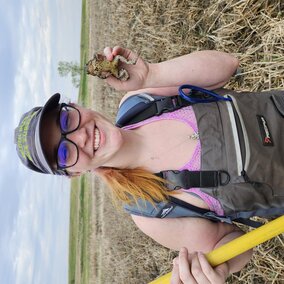
Calcium Supplement in the diet of a Tiger Salamander is Harmful To Their Eyesight (2019) & Other research (2017)
By Allison Crothers
Click to See Poster
(Hatchling Snake Research)
Western Tiger Salamanders (Ambystoma mavortium) Responses to Monoammonium Phosphate Soil Application Exposures (2019)
By Lexy Polivanov
Analyzing Growth rate of juvenile Ornata Box Turtles from Nebraska Sand Hills Habitats," School of Natural Resources (2016-2017)
By Curt Vandenberg
Western Barred Tiger Salamander Status & Occupancy in NE (2016)
By Grace Bullington
Does Usage of Fungicides Negatively Impacts Anuran Tadpole Growth (2015-2016)
By Paige Krupa
Behavioral Learning in Juvenile Aquatic Turtles (2014-2015)
By Allison Hough
Reproductive Behavioral Changes Due to Nutrimental Constrains in Geckos (2014-2015)
By Lisa Keys
Barred Tiger Salamander Conservation in Urbanized Locations (2014-2015)
By Brooke Welsh-Appleby
Effects of Diet on Caudal Autonomy in Geckos (2014-2015)
By Carolyn Reiland-Smith
Spatial Ecology of the Pygmy Rattlesnake
By Dylan Maag
After working with Dennis I got my M.S. in Biology at Missouri State University with Dr. Brian Greene. My thesis research was focused on the spatial ecology and habitat selection of the pygmy rattlesnake, Sistrurus miliarius. I continued my education with Dr. Rulon Clark and attended my PhD in Evolutionary Biology from San Diego State University and the University of California, Riverside. My dissertation research focuses on the behavioral and ecological mechanisms underlying differential fitness and their relationship to an individual’s ancestry using a rattlesnake hybrid system (Crotalus scutulatus x viridis).
Where are they now?
Maag graduated from the University of Nebraska-Lincoln in 2014 with a Bachelor of Science in Fisheries and Wildlife, establishing a strong foundation in conservation biology. He further advanced his education at Missouri State University, earning a Master of Science in Biology in 2017. Maag then pursued and graduated in 2023 with a PhD in Evolutionary Biology through a collaborative program at San Diego State University and the University of California and continued at San Diego as a Postdoctoral Researcher. Today, Maag is an Assistant Professor of Biology in the Department of Life, Earth, and Environmental Sciences at West Texas A&M University (WTAMU). In addition to his teaching and research responsibilities, Maag is the Curator of the Herpetology Collection in the Biodiversity Museum at WTAMU, where he oversees the curation and management of valuable biological specimens. His multifaceted roles reflect a deep commitment to education, research, and the promotion of biodiversity, positioning him as a respected leader in his field.